

Start every setup with a baseline
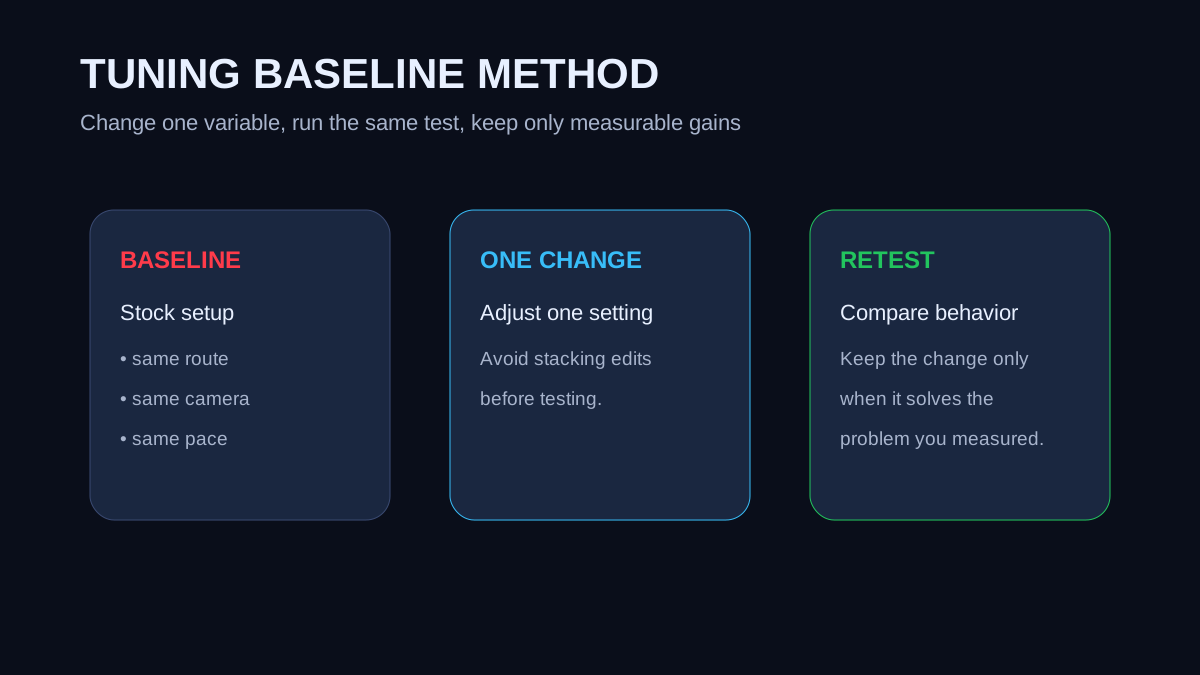
This Ghost Driver tuning guide begins with one rule: never tune a car you have not tested in a repeatable way. Drive a short section with the current or stock setup and pay attention to three behaviors: how quickly the car changes direction, how stable it feels after the lane change and how easily you can recover after slowing down. The purpose of the baseline is not to produce a perfect lap. It gives you something stable to compare against after each adjustment. Without a baseline, every change becomes a guess based on memory.
Use the same camera, road section and approximate speed for every Ghost Driver tuning guide test. If you change the route while changing the setup, you cannot tell which factor caused the improvement. Record simple notes such as stable, nervous, slow recovery or difficult to unwind. Those descriptions are more useful than chasing a number you cannot verify. Ghost Driver is still in Pre-Alpha, so a practical testing routine is more durable than copying a community setup that may have been built for an older handling model.
Change one variable at a time
The most common tuning mistake is changing several settings together and then deciding the car feels better. A useful Ghost Driver tuning guide avoids that problem by isolating one variable. If you are testing a setting related to steering response, leave the rest of the setup alone. Run the same road section several times and decide whether the car now solves the specific problem you identified. If it does, keep the change and move to the next issue. If it does not, return to the baseline rather than stacking another adjustment on top of an uncertain result.
One-variable testing also makes the Ghost Driver tuning guide easier to use after an update. When handling changes, you can quickly identify which part of the setup no longer behaves as expected. Players who copy a complicated setup without understanding it often have to start over after balance patches. Players who know why each adjustment was made can rebuild much faster. The goal is not to memorize one permanent configuration. The goal is to understand the relationship between a setup change and the behavior you feel on the highway.
Tune for traffic cutting, not a garage number
A Ghost Driver tuning guide should reflect the actual gameplay. Traffic cutting demands quick but predictable lane changes, stable recovery and enough acceleration to regain speed after you back out of a closing gap. A setup that feels impressive in an empty section may become difficult when traffic forces repeated corrections. Test in conditions that resemble the way you normally play. If your car rotates quickly but requires constant counter-corrections, the extra response may cost more time than it saves during a long run.
Think about the complete sequence of a traffic cut: approach, move, stabilize and prepare for the next gap. The Ghost Driver tuning guide priority is a setup that makes all four stages repeatable. If the car is excellent at entering a gap but unstable afterward, it creates a new bottleneck. If it is very stable but too slow to respond, you may miss openings. Balance is more useful than maximizing one characteristic. The best setup is the one that lets you make the next decision sooner and with less correction.
- Approach traffic at a repeatable speed.
- Make one normal lane change.
- Measure how much correction is needed to stabilize.
- Slow down once and test acceleration recovery.
- Repeat before deciding whether the tuning change stays.
Separate driving problems from setup problems
Not every crash is a tuning problem. This Ghost Driver tuning guide recommends retesting the stock or baseline setup whenever an issue appears inconsistently. If the car only feels unstable when you enter a gap too late, the real problem may be timing rather than handling. If the same unwanted movement happens during several controlled tests, then tuning is more likely to help. This distinction prevents endless setup changes that mask a driving habit instead of improving the car.
A simple Ghost Driver tuning guide diagnostic is to reproduce the problem on demand. Can you make the car show the same behavior three times on the same stretch? If yes, change one relevant setting and repeat. If no, simplify the test until the cause becomes clear. This approach is slower for the first few minutes but faster overall because every adjustment has a reason. It also stops you from ruining a stable setup after one unlucky traffic encounter.
Retest after updates and new cars
Pre-Alpha development makes retesting an essential part of any Ghost Driver tuning guide. A handling patch can change how an old setup feels even when the visible settings remain the same. After a significant update, return to your baseline route before making new adjustments. Do not assume that a setup shared weeks ago still produces identical behavior. Treat community builds as hypotheses: useful ideas to test, not permanent facts.
The same Ghost Driver tuning guide logic applies when you move to another car. A configuration that works well on one vehicle may not solve the same problem on another because the starting behavior is different. Test the new car before copying any values. Identify its strongest and weakest behaviors, then tune against those observations. This creates setups that fit the car you are actually driving rather than a generic idea of what a fast car should feel like.
Keep a small setup log
The final Ghost Driver tuning guide habit is keeping a small setup log. You do not need a spreadsheet full of technical data. Record the car, the baseline problem, the single adjustment and the result. Notes such as “less correction after lane change” or “better recovery but too nervous at speed” are enough to preserve what you learned. When you return after an update, those notes tell you which changes were deliberate and which ones can be removed.
A reliable Ghost Driver tuning guide is ultimately a testing process rather than a magic preset. Establish a baseline, change one variable, use a realistic traffic-cutting test and keep only changes that solve the problem you measured. Recheck the setup after updates and repeat the process for every new car. That method produces a garage built around your driving rather than around unverified numbers, and it remains useful even as Ghost Driver continues to change during development.